If you’ve used ChatGPT, Claude, Gemini, or any other AI tool, you’re not alone.
Millions of entrepreneurs are experimenting with AI every day. They use it to write social media posts, generate emails, brainstorm ideas, summarize documents, and create marketing content.
The problem is that most people are using AI randomly.
They open ChatGPT when they need something, type a quick prompt, get a response, copy it somewhere, and move on. The next day they repeat the process from scratch.
At first, this feels productive.
Eventually, it becomes frustrating.
You spend time rewriting prompts, correcting outputs, searching through old conversations, and trying to remember what worked last time. Instead of creating leverage, AI becomes another tool that requires constant attention.
The entrepreneurs getting the biggest results from AI are not simply using AI more often.
They are building AI workflows.
An AI workflow turns AI from a tool into a system. Instead of relying on memory and repetition, you create repeatable processes that generate consistent results.
In this article, you’ll learn what an AI workflow is, why most business owners are wasting time with random AI usage, and how to build simple workflows that can save hours every week.
What Is an AI Workflow?#
In plain English, an AI workflow is a repeatable process that uses artificial intelligence to complete a task.
Instead of manually starting from scratch every time, you create a structured sequence of steps that produces the same type of outcome over and over again.
Think about how most entrepreneurs currently use AI.
They have an idea. They open ChatGPT. They type a prompt. They review the answer. They copy and paste the result somewhere else. Then they repeat the process tomorrow.
That is not a workflow. That is simply using AI as a tool.
A workflow goes much further. A workflow defines:
- What starts the process
- What information is provided to the AI
- What happens after the AI generates a response
- Where the final result is stored or used
The difference might seem small, but it changes everything.
Using AI vs Having an AI System#
Using AI:
- Open ChatGPT
- Think of a prompt
- Generate content
- Copy and paste it manually
- Repeat tomorrow
Having an AI system:
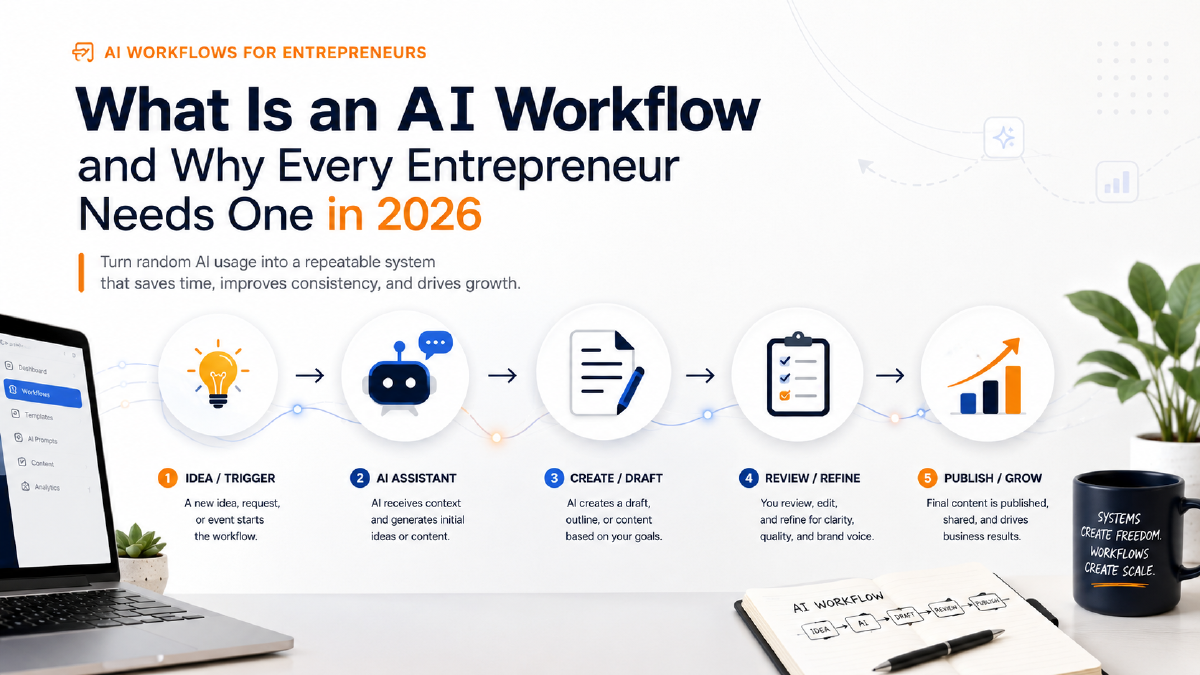
- New content idea enters your workflow
- AI generates an outline
- AI expands the outline into a draft
- Content is reviewed
- Final version is published or scheduled
One approach depends on you remembering every step. The other creates a repeatable process.
That is why successful entrepreneurs are increasingly focused on systems rather than tools. Tools can help you work faster. Systems help you scale.
Why Random AI Use Is Costing You Time Instead of Saving It#
Many entrepreneurs assume that using AI automatically makes them more productive. Unfortunately, that is not always true.
In fact, random AI usage often creates hidden inefficiencies that waste time every day.
The Prompt and Pray Trap#
One of the biggest mistakes entrepreneurs make is what I call the prompt and pray approach.
You open an AI tool, type a quick request, and hope for a great result. Sometimes it works. Sometimes it doesn’t. When the output isn’t what you wanted, you rewrite the prompt, try again, and continue tweaking until you get something usable.
This cycle can easily consume thirty minutes for a task that should have taken five. Without a structured workflow, every request becomes an experiment.
Starting From Scratch Every Time#
Imagine hiring an employee and forcing them to relearn their job every morning. That sounds ridiculous. Yet that is exactly how many entrepreneurs use AI.
Every day they create new prompts from scratch. Every day they explain their business again. Every day they rebuild the context.
A good AI workflow preserves knowledge, structure, and context so you are not constantly reinventing the wheel.
No Consistency in Outputs#
Consistency matters in business. Your content should sound like your brand. Your proposals should follow a standard format. Your client communication should feel professional and predictable.
Random AI usage often produces inconsistent results because every prompt is different. A workflow creates standards. When the same process runs every time, the quality becomes much more reliable. That consistency compounds over weeks, months, and years.
The Three Components of a Real AI Workflow#
Most AI workflows can be broken down into three simple components. Once you understand these, you can build workflows for almost any area of your business.
1. Trigger#
The trigger is what starts the workflow. It is the event that tells the system it’s time to begin.
Examples include:
- A new client inquiry arrives
- A content idea is captured
- A meeting ends
- A form is submitted
- A task is created
2. Prompt#
The prompt is the information and instructions provided to the AI. A strong prompt includes:
- Clear instructions
- Relevant context
- Desired output format
- Brand voice guidance
- Specific objectives
The better your prompt structure, the more reliable your results become. Many entrepreneurs create prompt libraries so they can reuse successful prompts rather than recreating them every time.
3. Output System#
This is the piece most people overlook. What happens after the AI generates a response? Where does the information go? What action happens next?
Examples include:
- Saving content to a document
- Sending an email draft
- Updating a CRM record
- Creating a task
- Scheduling content for publication
Without an output system, AI creates information but not action. The real value comes when AI becomes part of a larger process that drives results.
Three AI Workflows Any Entrepreneur Can Use Today#
You do not need advanced software or technical skills to benefit from AI workflows. Here are three you can implement immediately.
Workflow #1: Content Creation Workflow#
Step 1: Capture a content idea. Step 2: Use AI to create an outline. Step 3: Use AI to expand the outline into a draft. Step 4: Edit the draft with your expertise and personality. Step 5: Publish the content.
Instead of staring at a blank screen, you move through a repeatable process that gets better every time you use it.
Workflow #2: Client Acquisition Workflow#
Step 1: A prospect submits an inquiry. Step 2: AI summarizes the inquiry. Step 3: AI drafts a customized proposal. Step 4: Proposal is reviewed and sent. Step 5: Follow-up reminders are generated automatically.
This workflow helps ensure every lead receives a professional response without requiring hours of manual effort.
Workflow #3: Weekly Planning Workflow#
Step 1: Brain dump everything on your mind. Step 2: Feed the information into AI. Step 3: AI identifies priorities. Step 4: AI organizes tasks by importance. Step 5: Tasks are added to your calendar or project management system.
This simple process helps you focus on what matters most instead of reacting to whatever feels urgent.
The Future Belongs to Entrepreneurs Who Build Systems#
AI is no longer a competitive advantage by itself. Almost everyone has access to the same tools.
The real advantage comes from how you use them.
Entrepreneurs who continue using AI randomly will spend their time rewriting prompts, repeating work, and chasing inconsistent results. Entrepreneurs who build AI workflows will create systems that save time, improve consistency, and scale their productivity.
The goal is not to replace human thinking. The goal is to eliminate repetitive work so you can focus on decisions, strategy, relationships, and growth.
The entrepreneurs who win in 2026 will not necessarily have the most AI tools. They will have the best AI systems.
Ready to Build Your First AI Workflow?#
If you’re serious about creating repeatable systems instead of relying on random prompts, start with a proven prompt library.
The AI Prompt Pack includes more than 50 practical prompts designed for entrepreneurs, creators, consultants, and business owners, organized by business function and ready to plug directly into your workflows.